How to Make a Small Backyard Feel Bigger: 7 Landscaping Mistakes to Avoid
Some backyards really are small.
But others have a surprising amount of usable space and still feel cramped.
That's because perceived size isn't only about square footage. The landscaping can make the property boundaries feel closer, shorten important views, create too much visual activity, or make every inch of the yard easy to measure at a glance.
And sometimes the things homeowners do specifically because their yard is small—using tiny plants, lining the entire fence with narrow beds, or squeezing more features into every open area—actually make the problem worse.
If your yard feels smaller than it should, these seven design choices are worth looking at before you try to fit anything else into it.
What Makes a Small Backyard Feel Bigger?
A small yard usually feels more generous when the eye can move through it without immediately understanding every boundary and dimension.
Larger-scale plants in the right places, softer property edges, longer sight lines, repeated planting, layered landscaping, and intentional open space can all make a yard feel less confined without changing its actual size.
Prefer to Watch?
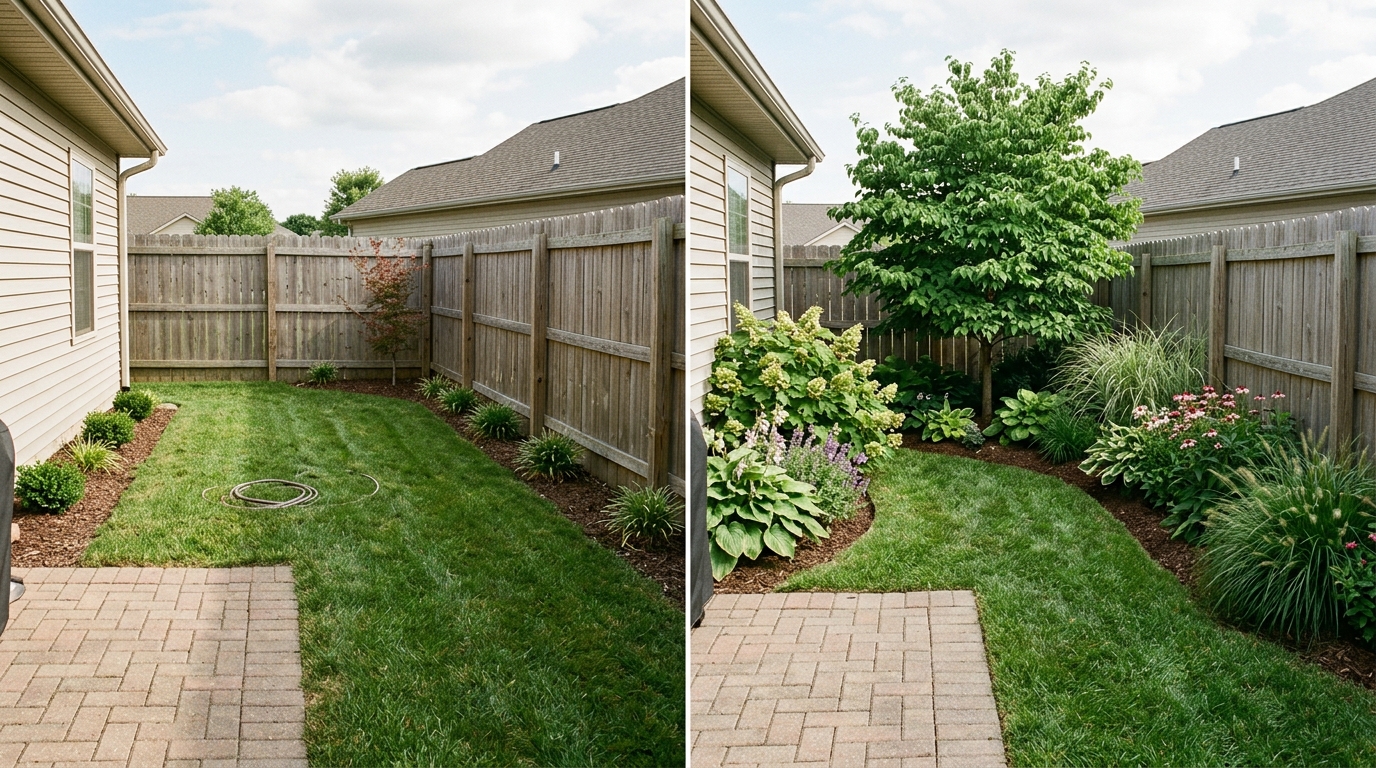
1. Don't Make Every Plant Small Just Because the Yard Is Small
It seems logical.
You have a small backyard, so you choose small things.
A compact ornamental tree. Small shrubs. Little grasses. Narrow planting beds so you don't lose too much lawn.
Everything fits comfortably.
And somehow the yard looks even smaller.
The problem is scale.
When every plant stays low and compact, the fence and house can suddenly feel enormous by comparison. Instead of making the landscape feel spacious, the planting becomes a thin decorative layer sitting along the bottom of much larger structures.
A small yard doesn't automatically need small plants.
Sometimes it needs one or two elements that are large enough to give the space believable scale.
A well-positioned tree can create a canopy overhead rather than occupying all of its visual space at ground level. A substantial shrub can add depth. A planting bed with enough width for layers can feel more generous than a narrow strip of plants pushed against the fence.
The goal isn't to fill a small yard with giant plants.
It's to choose a few plants that are appropriately scaled for the job they're supposed to do—and to account for the size they'll eventually reach.
Garden Guru takeaway:
Sometimes the thing making a small yard look small is that everything in it looks small.
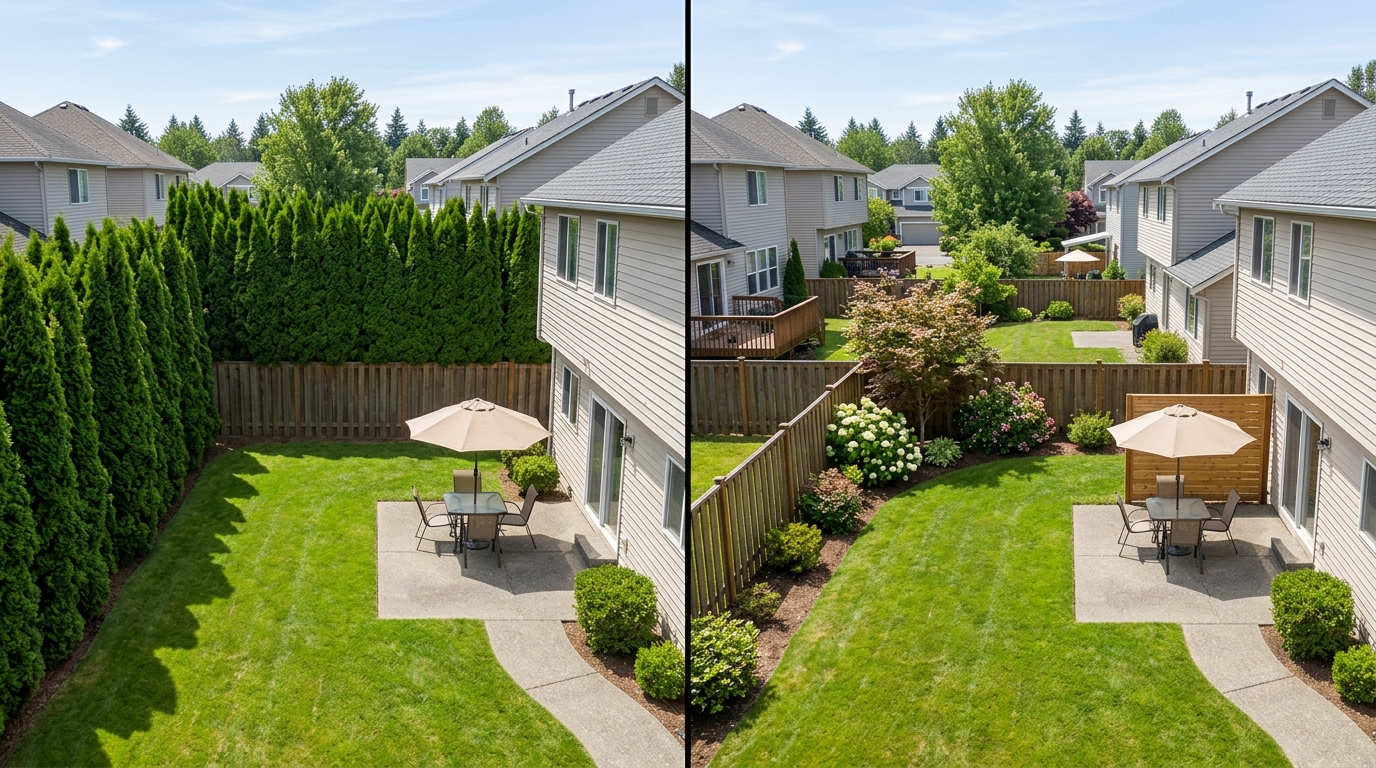
2. Don't Turn Privacy Into a Wall Around the Entire Yard
Privacy is a real concern in many suburban backyards.
A neighbor can see onto the patio, so you plant a hedge.
Another window feels exposed, so you add evergreens.
Then you put a screen on the other side.
Eventually, you've solved the privacy problem—but everywhere you look, your eye hits something tall.
Fence.
Hedge.
Screen.
Another hedge.
The yard starts feeling like a room with very high walls.
The important distinction is that you usually don't need privacy everywhere.
You need privacy from something specific.
Maybe it's one second-story window. A neighbor's deck. A direct view onto your seating area.
Once you identify the actual sight line, you can screen that view strategically instead of building a continuous visual barrier around the entire property.
A tree, group of taller shrubs, or screen near the seating area may solve the problem while leaving other directions more open.
Because privacy and enclosure aren't the same thing.
You can have enough of the first without creating too much of the second.
3. Stop Outlining the Exact Size of the Yard
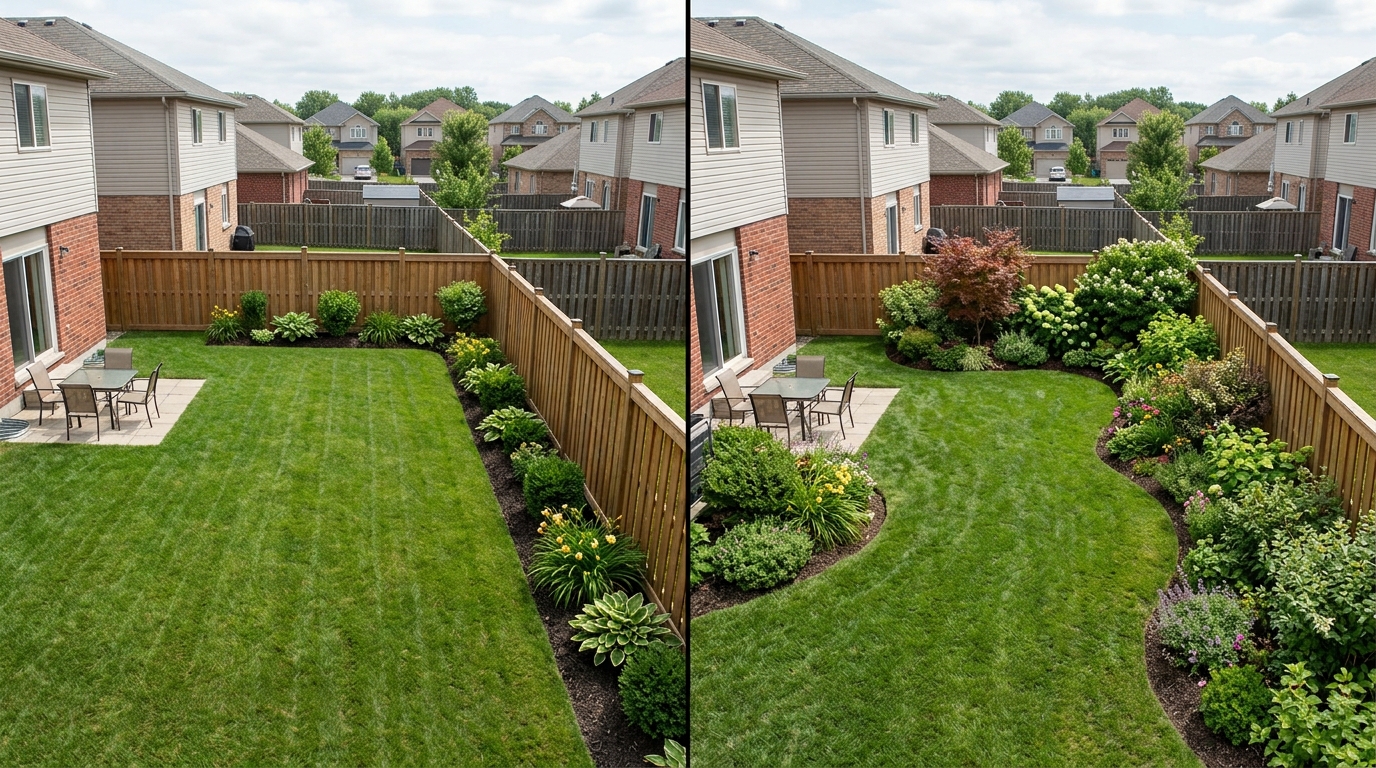
One of the most common suburban backyard layouts is also one of the easiest ways to emphasize a yard's boundaries.
Fence across the back.
Fence down both sides.
A narrow planting bed following the fence around the entire perimeter.
Lawn in the middle.
It's tidy and organized.
But visually, it creates a picture frame around the exact dimensions of the property.
Your eye can follow the planting bed around the entire yard and immediately understand where one edge ends, where the other begins, and exactly how far apart they are.
That can make even a medium-sized backyard feel surprisingly contained.
You don't have to eliminate perimeter planting.
Instead, make the edges less predictable.
Let the bed move farther into the lawn in one location and narrow somewhere else.
Use a tree or larger shrub to obscure part of the fence.
Allow the lawn to move around planting rather than sitting inside a perfect rectangle.
You're not trying to convince anyone the property is twice its actual size.
You're simply avoiding the visual equivalent of drawing a heavy black line around the entire yard.
I designed the FREE Yard Style Finder to help people discover their preferred yard style. It's a great first step in the journey of making your yard exactly what you want it to be. Click the link below to use it
4. Protect the Longest Views Through the Yard
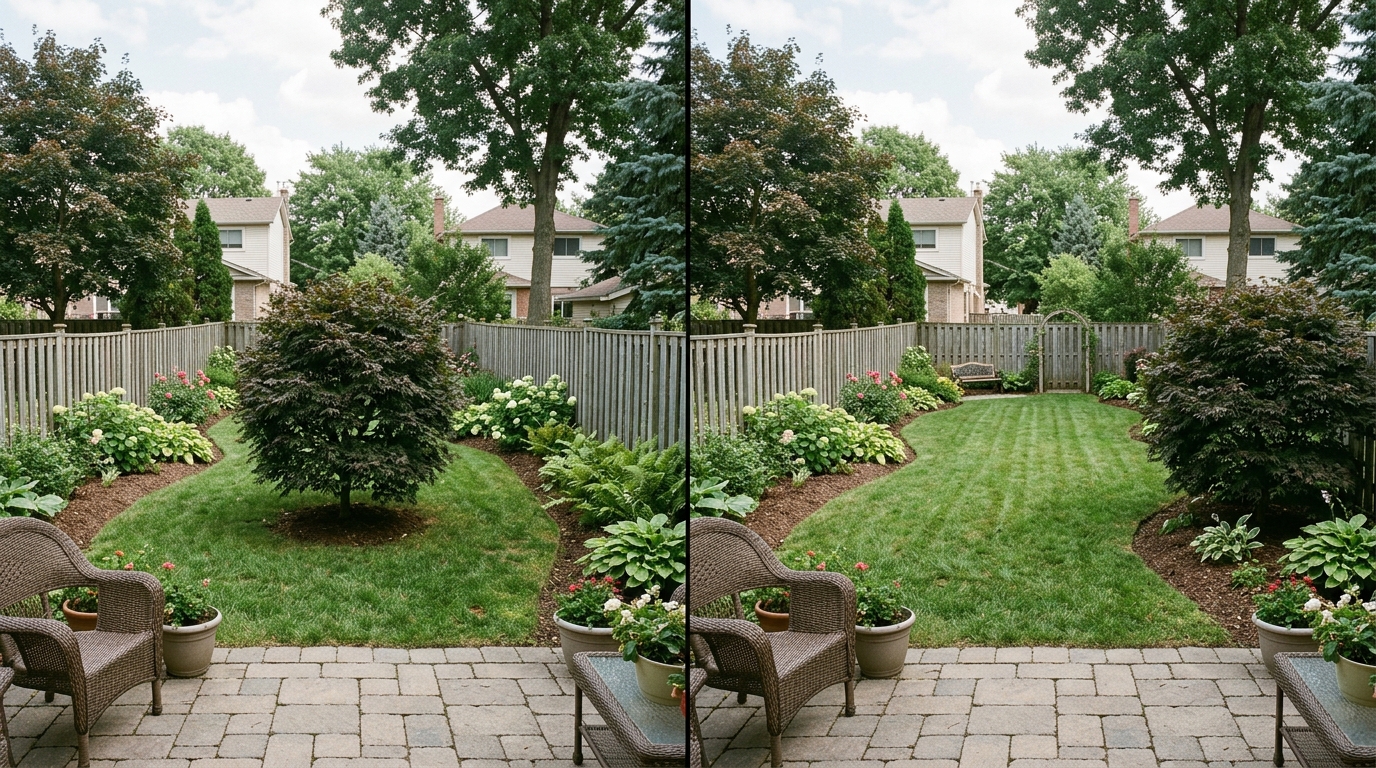
The placement of one object can make a surprising difference in how deep a yard feels.
Imagine standing on the patio and being able to see all the way to the opposite end of the property.
Now place a tall shrub, specimen tree, screen, or small shed directly in the middle of that view.
The backyard hasn't physically changed.
But visually, it may suddenly feel much shorter.
Your eye stops at the object instead of continuing through the landscape.
That's why sight lines matter so much in smaller yards.
You don't necessarily want every important feature sitting directly in front of you.
Try moving a focal point farther away.
Protect a diagonal view across the property.
Place a tree slightly off-center so the eye can travel past it rather than stopping against it.
The same tree or shrub might work beautifully ten feet to one side and feel completely wrong when placed directly in the primary view.
Placement changes perceived space—not just the size of the object.
5. Repeat Plants Instead of Making Every Plant an Event
Another way small yards become visually cramped has nothing to do with physical dimensions.
It's simply too much information.
One interesting shrub.
One unusual ornamental grass.
One purple-leaf plant.
One flowering perennial.
One small tree with distinctive bark.
Then another interesting plant.
And another.
Nothing is necessarily unattractive.
But every few feet, your eye encounters a completely different shape, texture, color, or height.
That creates visual stops.
And the more often your eye stops, the busier—and often smaller—the landscape can feel.
Repetition does the opposite.
Repeat the same shrub in several locations.
Use the same ornamental grass along a path.
Let one perennial appear as a larger mass and then repeat it elsewhere.
Now the eye recognizes patterns and moves more easily through the yard.
The goal isn't to make the garden boring.
It's to stop asking every square foot to prove how interesting it is.
Sometimes fewer plant varieties used more intentionally create a landscape that feels richer and more generous.
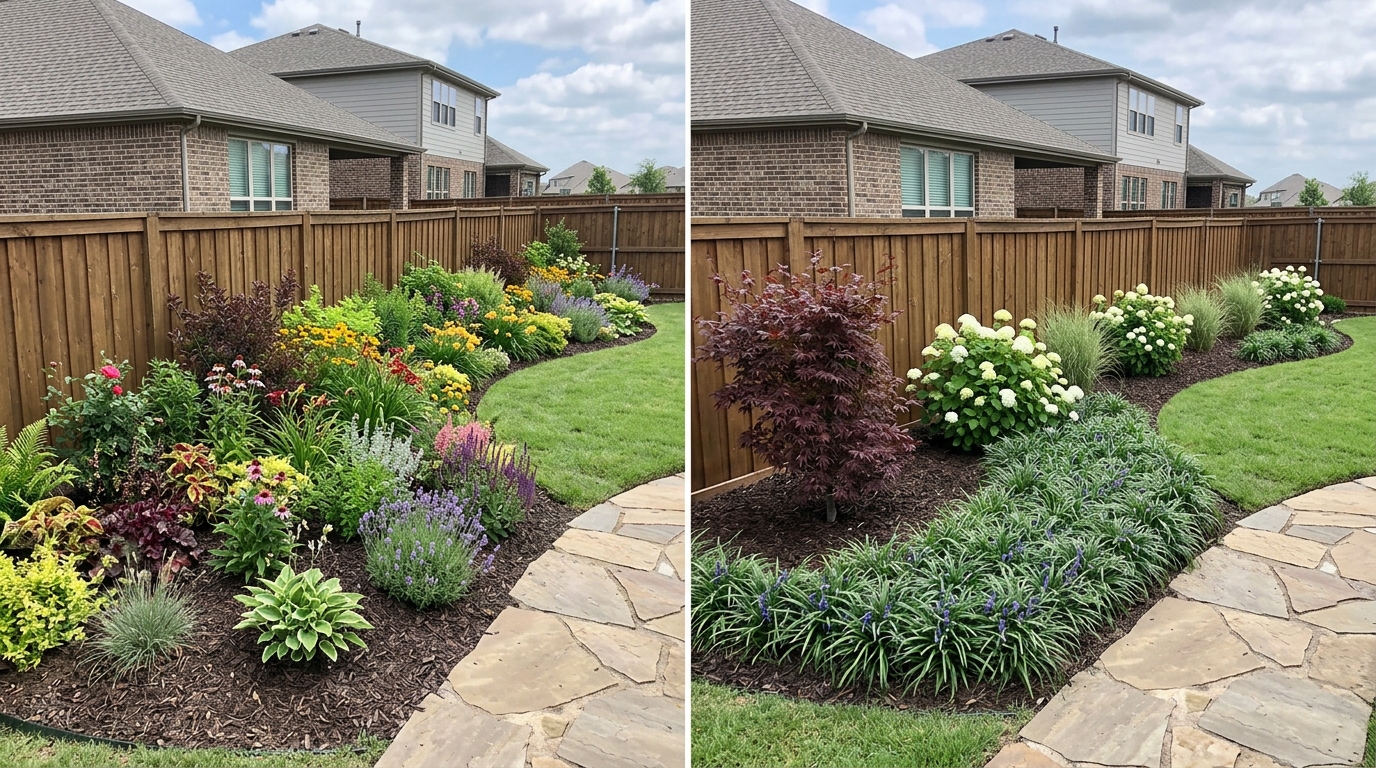
6. Don't Let the Patio Become the Entire Backyard
It often starts reasonably.
You need room for a table, so the patio gets larger.
Then you add a grill.
Maybe you want lounge furniture.
The patio expands again.
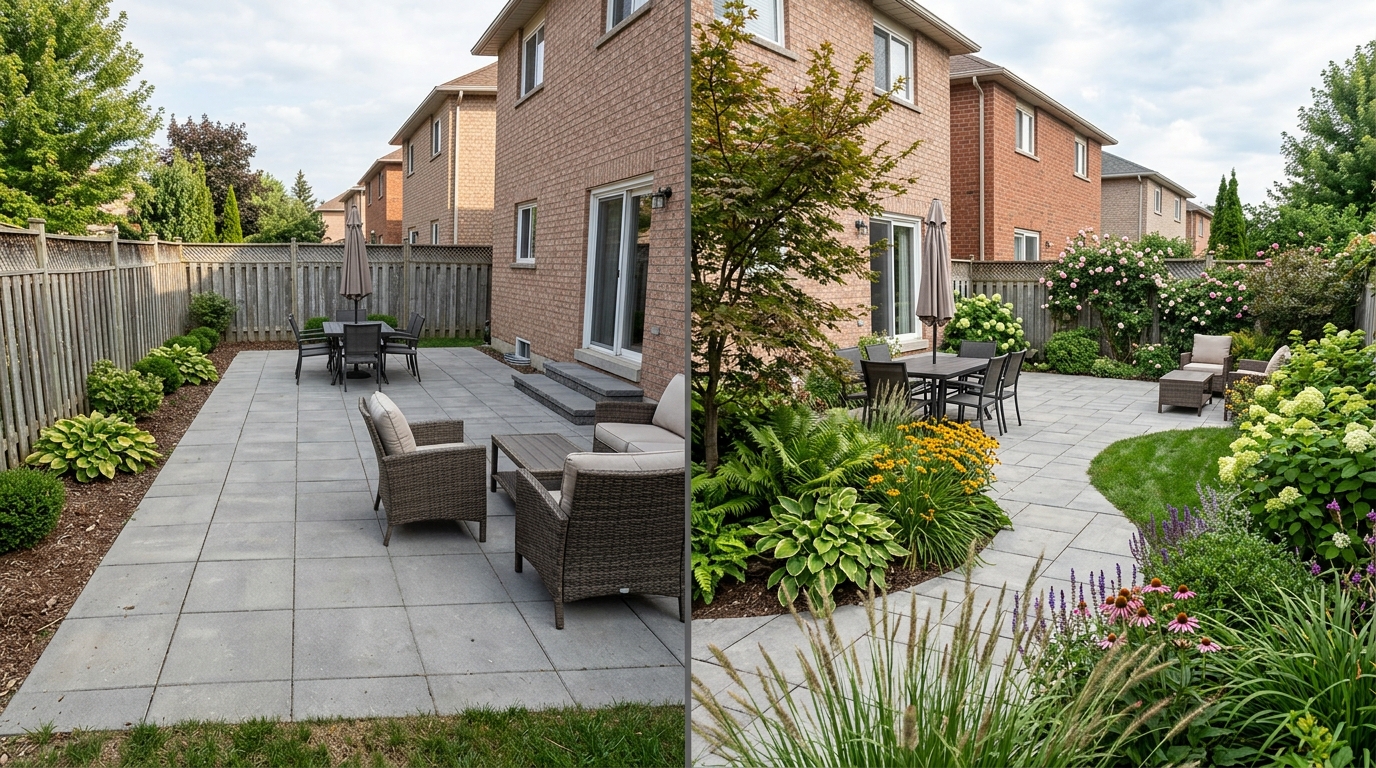
Eventually, hardscape stretches across most of the space between the house and the fence.
Technically, you've created more usable surface.
But the yard can actually start feeling smaller.
Large uninterrupted hardscape is easy for the eye to measure.
You can see the entire floor of the yard at once—where it starts, where it stops, and the distance between every edge.
Planting works differently.
Shrubs overlap other shrubs.
A tree canopy creates another layer overhead.
A planting bed moves into the edge of a patio.
Your eye moves through layers instead of across one flat surface.
This doesn't mean a patio should be tiny.
If your household genuinely needs a large patio, build one large enough to function properly.
But consider allowing the landscape to interrupt it.
Bring a planting bed into one corner.
Leave room for a tree.
Soften an edge with grasses or shrubs.
The goal isn't less usable space.
It's avoiding one uninterrupted surface that makes the backyard's dimensions immediately obvious.
7. Leave Some Space Intentionally Empty
This may be the easiest mistake to make.
You finish a planting bed and notice a gap.
Add another plant.
There's an empty corner beside the patio.
Add a container.
The wall looks blank.
Put something there.
There's unused lawn.
Maybe it needs another feature.
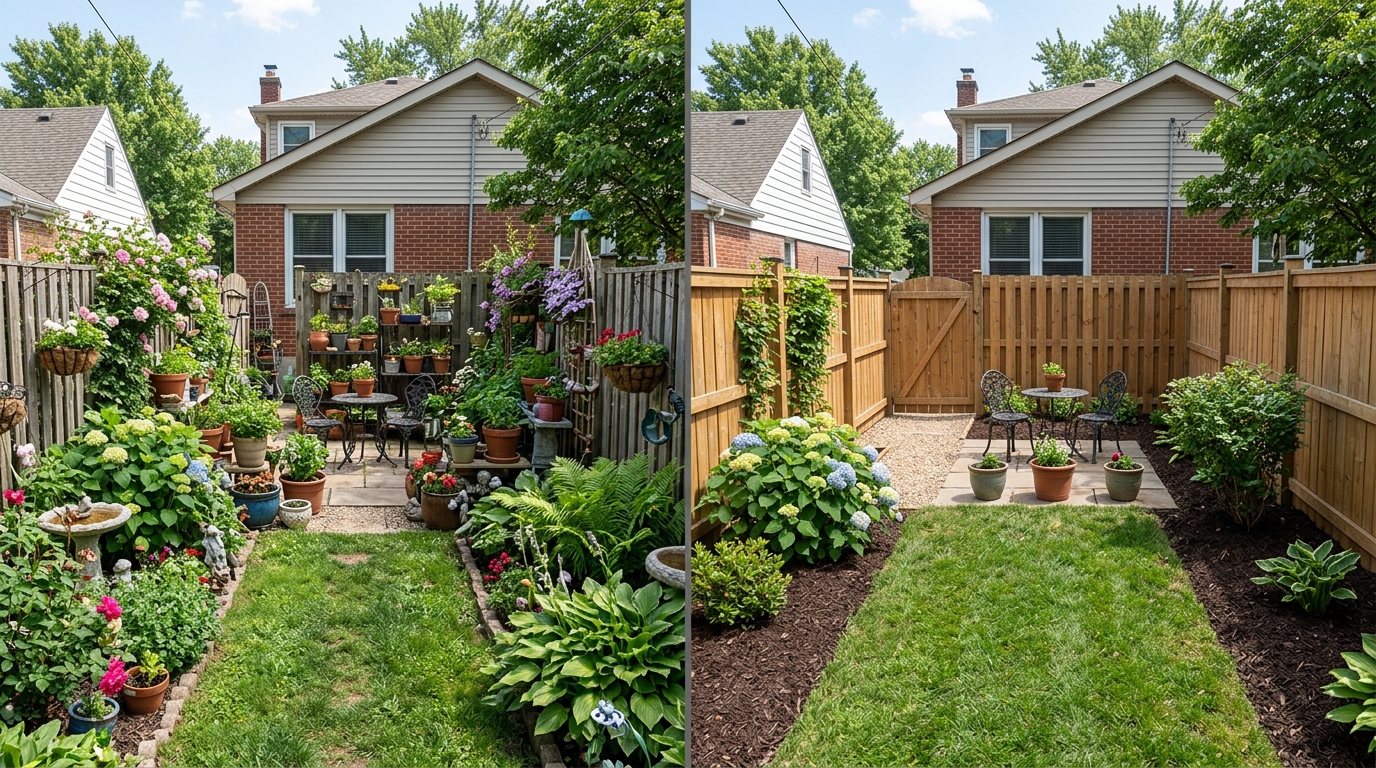
Little by little, every open part of the yard gets assigned an object.
But empty space isn't automatically wasted space.
Sometimes it's what allows the rest of the landscape to work.
A patch of open lawn gives planting beds room to feel substantial.
Visible mulch gives young plants somewhere to grow.
A simple wall makes the plant in front of it more noticeable.
An open edge makes a seating area feel less crowded.
Designers often call this negative space, but the principle is simple:
Everything doesn't need to be filled.
And that matters even more in a small yard.
If every available spot contains another pot, plant, piece of furniture, or decorative feature, the landscape starts advertising how little room remains.
Before filling an open area, ask:
Does anything actually need to go here?
Sometimes leaving it alone is the design decision.
Want Help With the Bigger Design of Your Yard?
If your yard feels cramped, disconnected, or difficult to organize, the solution usually isn't simply fitting more into it.
Download the free 5 Yard Design Moves That Fix Almost Any Outdoor Space guide for practical ways to improve the overall structure of your landscape.
Making a Yard Feel Bigger Is Really About What the Eye Notices
You can't design your way into additional property.
But you can change how clearly the landscape announces its dimensions.
When every boundary is obvious, every view is interrupted, every plant is different, and every open area is filled, your brain can understand the entire yard almost instantly.
That makes it easy to measure.
Longer views, repeated planting, softer boundaries, appropriately scaled elements, layers, and a little breathing room do something different. They allow the landscape to unfold more gradually.
So if your backyard feels smaller than it should, don't immediately ask:
“How can I fit more into this space?”
Ask:
“What is making this space feel smaller than it really is?”
Sometimes the answer is adding the right plant.
Sometimes it's moving something.
And sometimes the best thing you can put in an empty corner is nothing at all.